Tuesday, March 30, 2010

How Not to Become Tools of Our Tools

Guest Writer, Nancy Evans

We have been using WebCT since 1999 and it is soon to be defunct when Blackboard, its current owner, will no longer support it. I have invited faculty to review some options and we have narrowed our search to Desire2Learn, a Canadian company which has managed to escape Blackboard's buyout, and Moodle, an open source course management system supported by Moodlerooms.

Let's clarify. An open source course management system is based on software which is not copyright protected. Since the source code for the software is available to anyone, users may change it, add to it and improve it as they see needs arise. And it is free.

So, why use a course management system? It is most advantageous to non-traditional students who may live at a distance from campus or cannot come to campus for classes. But these are not the only students who can benefit.

Perhaps an instructor wants computer-based or internet-based enhancements to their instruction. This is done by giving students access to specific information, access to each other in discussion groups, by calculating and posting grades online, by creating test banks and controlling access to tests, or by providing a learning environment very different from a traditional classroom — all in a password-protected online world.

And what about the online world at large? How can one gain access to people and information on the internet? A course management system can gather in one place controlled access to social networking tools and provide guidelines for students working on the internet.

Let's clarify. Social networking tools are free internet-based applications that allow one to share information and media with others. Examples include the ubiquitous Facebook, blogs, Twitter, YouTube, and Flickr, as well as the somewhat lesser-knowns, such as Ning, Meebo, dimdim, and SlideShare (see the ATS website for explanations). Note that though you may be able to control your privacy to some extent, you should consider social networking tools as opening your life up to the world.

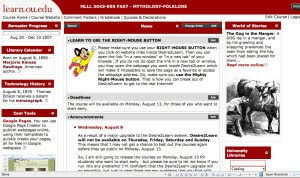
So why not use a blog instead of a course management system? Simply put, ease and control. Most course management systems are quite linear in design, offering a default set of elements: drop box, discussion list, gradebook, chat room, email. These tools reflect a fairly traditional teaching approach - presentation, discussion, assessment - and most instructors use these elements easily and successfully. And most instructors are effective in classes organized on this model, whether in class or online. Here is a traditional course management system.


However, more modern course management systems offer more customization and new features associated with social networking tools, such as wikis and blogs. The course itself can look different and can be laid out as a portal (or not - there are choices). The portal layout will still give access to the traditional course management tools, but it changes how the instructor designs the course and how students interact with the tools. The portal design looks more like a website or a blog and may encourage delving into the tools to see which ones serve one's needs and which tools will further the learning objectives of the course.
Most instructors want to know what a course management system - or any technology - can do and how hard is it to learn. I think a better question is how can a course management system, or any technology, meet my pedagogical goals and my students' learning objectives?

How might an instructor's choice of course management tools be affected or determined by learning objectives? Consider these broad learning objectives:

  • Students will demonstrate a depth of knowledge and apply appropriate methods of inquiry
  • Students will interpret information, respond and adapt to changing situations, make complex decisions, solve problems, and evaluate actions
  • Students will demonstrate the inclination to be life-long learners, a concern to become and remain well informed, the ability to retrieve and manage information appropriately, open-mindedness regarding divergent worldviews, and a willingness to reconsider and revise their own views when warranted (K-State Undergraduate Student Learning Outcomes. http://www.k-state.edu/assessment/slo/undgradobj.htm Retrieved 3/30/10).
In response, consider these questions:
  • How is a student's understanding of drug rehabilitation programs (for example) enhanced by access to actual programs and counselors online? How can that knowledge be share and compared with other students, even those at other universities?
  • How does a student-run blog help students interpret, respond and adapt to new information?
  • How can an instructor encourage students' innate or latent curiosity in a subject with internet and course management tools?

We will move into a new phase of online learning and teaching when we choose a new course management system. How will we make our courses more effective, more responsive to learning objectives, more responsive to students? How can we enrich our students' learning? What new tools, or old ones, will we choose?

And, finally, how will we avoid this technology trap:

"Men have become the tools of their tools." -- Henry David Thoreau, Walden

Saturday, March 20, 2010

Teaching/Politics

Guest Writer: Chieke Ihejirika

Teaching is a lot of things. It is an exercise in delivery and the midwifery (Plato) of knowledge about certain subject matter. It is for me an opportunity to do, at least, four things, namely: put forward my original ideas seeking publication; comment on other people’s ideas in a systematic manner; ensure that the students participate in the discourse in a way that leads to some expansion of their awareness of the subject matter; and it must involve some extrapolation seeking relevance for their daily life.

When I teach American government and politics, I am confronted by the current quagmire or deadlock in government, especially the inability to solve any of the major problems facing America. Common sense seems to suggest several solutions, but the reality seems impossible to manage. But what is the reality? The reality is artificial complications created by self-seeking persons playing God in their opposition to change.

One theme I want to share with the community is the future of America as we know it. This country was founded on the principle of "No taxation without representation." This principle held sway until the 20th Century. Yes! Prior to the Great Depression America operated on the Jeffersonian dictum that "Government is best that governs the least." Under the political economy of slavery and discrimination, government was able to escape its basic duties to the people under the 'social contract', by simply denying some of its citizens their basic rights.

Things have changed as justice seems to have been enthroned universally in the country. Hence, citizens who were earlier denied basic rights and privileges of citizenship now demand and get those rights, including social security and unemployment benefits, and these have to be paid for. Yet the only way government gets money is through taxes. Since the twentieth century, the people have gotten used to getting benefits from their government to help them with economic difficulties, and the national government itself has also grown very big as a global power which is also carries a big price tag. Can the country continue its aversion to taxation? I think the real fraud is making the people believe that the country can sustain itself and provide them with the necessary benefits they now cherish only by borrowing. American politicians, especially those of the ideological right, have since adopted the strategy of deception by making the people vote for only those who claim they will not raise taxes. Unfortunately, the people have naively, bought this baloney. Yet, when they get in there, they only borrow more, thus mortgaging the future of their posterity. The politicians have chosen to represent the people but without allowing themselves to be taxed. They still take all the financial remunerations of the offices they occupy on borrowed funds, even from the countries future rivals. They cynically know that it the poor masses that will pay this debt they continue to accumulate on the country. Besides, the interest alone is sure to deprive the government of future resources with which it could provide for the most vulnerable member for decades to come.

Questions:
Can the American political economy continue to grow as it did under unfettered laissez faire in the era when welfare capitalism has become the norm in the major industrial economies of the world?

Could it be that the American capitalist is moving abroad because of the loss of slave labor in America?

Saturday, March 13, 2010

What is Praxis and how can every department help our students pass it?

Guest Blogger: Emery Petchauer

Praxis I is the common name for the Pre-Professional Skills Test (PPST) or teacher licensure test(s) that all students in Pennsylvania must take in order to become certificated teachers. Not only must students pass it to become licensed teachers, they must pass it (i.e., a reading, writing, and math test at roughly 8th grade content—approximately 40 questions each) before they can declare education as a major. Thus, education is a major that students must test into. This gatekeeper position of the exam is not because it identifies students who hold promise as effective educators; rather, the position is due to program accreditation demands set by the Pennsylvania Department of Education (as it the 3.0 minimum GPA requirement)

At time of this writing, there are 41 students enrolled on the main campus who have passed Praxis I. Some of these students passed all three parts on their first attempt, and some passed on multiple attempts. There are approximately 25 more students who have passed different combinations of the three required sub-tests and are working toward passing all of Praxis I. This number of passing students has increased since the education department centralized our preparation efforts in 2007 by creating the Praxis Cohort tutorial, and these efforts are modified each year to continually improve our program.

Despite these improvements and efforts, passing Praxis remains a significant challenge for many of our students and is the most common reason students change majors or are counseled to do so. This difficulty in passing Praxis is due to (a) some inadequate high school educations, (b) previous failure experiences with standardized tests, (c) the cultural and social class bias of such tests, and (d) misinformation about the test, which creates cognitive and affective dispositions that decrease the likelihood of passing (i.e., the ideas that “nobody” passes the test).

Since Lincoln University holds accredited teaching programs in many secondary fields (e.g., mathematics, biology, English, Spanish, history and social studies, etc.), each school on campus graduates teachers. In this way, each school can be a part of successfully preparing our students to pass Praxis by content and disposition. Preparation in terms of content is rather straightforward in that some classes in the mathematics, English and mass communications, and education departments (and thus our three schools) connect most directly with the three areas of Praxis I. The second area, dispositions, I believe is equally important and is more relevant to every department on campus.

What people believe about their capabilities on specific tasks significantly shapes the decisions they make, how much effort they exert, how much they persistence through obstacles, how much stress and affective burden they experience, and their perceptions of accomplishment. Beliefs, in fact, are often more important to motivation and affective states than what is objectively true. These points come from the extensive body of research on self-efficacy ala Albert Bandura (1997). Self-efficacy is shaped by four information sources: previous mastery experience, vicarious experience, verbal and social persuasion, and physiological states.

What all of this means to every department on campus is that by giving students vicarious successful experiences (e.g., highlighting the successful experiences of students “just like them”), and by giving students positive verbal and social persuasion about Praxis related skills (e.g., “I’ve seen your writing in class, and I think you will pass Praxis writing), professors play an integral roll in helping improve students’ Praxis efficacy. Similarly, being careful not to talk about the test and testing experiences in ways that decrease self-efficacy (e.g., “Lincoln students don’t do well on Praxis”) helps our students pass.

Here are some other factual pieces of information that you can easily tell students when the topic of Praxis comes up:
  • People just like you pass Praxis all the time
  • Some people pass the first time they take it; some have to study to pass
  • There are over 40 students on campus right now who have passed all parts of Praxis
  • One students last year missed only 1 question on the math test
  • Another student’s math score improved 13 points (out of 40) after studying for the math test for 8 weeks
  • You only have to get about 55% correct to pass—not 100%

Here are some things to avoid saying because they will likely decrease self-efficacy and/or they are not true:
  • African American students do not perform well on standardized tests
  • Lincoln students don’t to well on Praxis
  • You can’t really study for Praxis
  • I was never good at tests like that

Related Resources:


Bandura, A. (1997).
Self-efficacy: The exercise of self control. New York: W. H. Freeman and Company.

Bennett, C. I., McWhorter, L. M., & Kuykendall, J. A. (2006). Will I ever teach? Latino and African American students’ perceptions on PRAXIS I. American Educational Research Journal, 43, 531-575.

Goldhaber, D., & Hansen, M. (2010). Race, gender, and teacher testing: How informative a tool is teacher licensure testing? American Educational Research Journal, 47, 218-251.

www.ets.org/praxis

Friday, March 5, 2010

The Six Principles of Effective Teaching

Guest Writer, Safro Kwame

What do you think of the new (February 2010) book, Teaching as Leadership by Teach For America, which claims that highly-effective teachers do the following?

"(1) Set ambitious goals for student achievement; (2) maintain high expectations for their students at all times; (3) begin every endeavor with the key questions “Where are my students now versus where I want them to be?” and “What is the best possible use of time to move them forward?;” (4) make good judgments about when to follow through on their plans and when to adjust them in light of incoming data; (5) are their own toughest critics; and (6) refuse to allow the inevitable challenges that they face to become roadblocks."

One of their slogans is: “In God We Trust. Everyone Else Bring Data.”

Please post your data and answer. I would love to "hear" from you. The question is: do you agree with Teach For America about the six principles of effective teaching (either for college or pre-college teaching, for underprivileged or privileged students, or both)?

See excerpts from the book:

http://media.wiley.com/product_data/excerpt/61/04704328/0470432861.pdf

See articles about the book:

What Makes a Great Teacher? The Atlantic Monthly January/February 2010

http://www.theatlantic.com/magazine/archive/2010/01/what-makes-a-great-teacher/7841/

Six Principles to Teach By, The San Francisco Chronicle, February 9, 2010

http://www.sfgate.com/cgi-bin/article.cgi?f=/c/a/2010/02/08/EDHU1BUEQB.DTL

See video about the book:

Secrets of America's Greatest Teachers, ABC World News, 2/26/2010

http://www.youtube.com/watch?v=2UmVXxpnB70

or

http://abcnews.go.com/WNT/video/secrets-americas-greatest-teachers-9961455

Friday, February 26, 2010

Learner Centered Education

Guest Blogger: Frank Worts

There is much talk today concerning the movement from teacher centered education, “the sage on the stage” as identified in an earlier posting on this blog, and student centered learning. From my perspective, student centered learning encapsulates many of the issues that we have been discussing on this blog and at our Faculty forums. Let me begin by identifying my view of learner-centered education.

To me, student-centered learning relies on the identification of the experiences, interests, capacities and needs of the students as the starting point of the educational experience. Based on this view of the learners, the learning focus then must include the best theories of learning and practice that are effective in promoting high levels of motivation, confidence and achievement Concretely, again from my perspective, there are four concepts that I believe are needed to support learner centered education.

  1. Each learner’s life experience, environment, culture, interests, goals, and beliefs need be identified and respected to create independent thinkers.
  2. Unique differences such as emotional perspectives, learning styles, rates of learning, talents, confidence and motivation must be addressed to promote the highest achievement.
  3. Real life learning activities must help learners connect new learning with prior knowledge and experiences. This produces better learning.
  4. An environment with positive interpersonal interactions facilitates the learner to feel acknowledged, respected, and validated (Henson, 2003).

So how would one address these five concepts in creating a learning centered environment at Lincoln University? From my perspective, the overarching prospective to accomplish this perspective is that the Masters of Human Services Program (MHSP) has to be extended beyond the Graduate Center Classroom environment to the adult students’ personal life, family life, community life, and their work and environmental realities. WebCT (or other good course management system) provide useful tools to expand the classroom to better engage the adult student in applying the MHSP content to their multiple environments. I will attempt to address how the above four concepts are integrated into the Introduction of Applied Sociology & General Systems Theory of the (MHSP), and perhaps generate some discussion that positively addresses our undergraduate and graduate students educational experiences at Lincoln.

Student Perspectives and Frames of Reference

To identify the perspectives and frames of references for each of the student, WebCT’s student profile module is used. Each student completes a personal introduction template and posts their picture with the profile. This exercise is followed by a personal, in class introduction where classmates can ask questions of the presenter. I model the interaction by asking elucidating comments and supporting areas that are identified and have individual classmates offer support or connect to the life events. To enhance this self understanding, the discussion module is used on a weekly basis where course concepts are applied to either the family, community or work environment with connection to their personal learning. To promote positive interaction, each student must academically critique or support the discussion posts of at least two of their classmates. My experience indicates that students will continue the discussions during class to gain clarity. My role in the discussions is minimal except to redirect if discussions are off target or if concepts are used incorrectly and no other student has intervened to make the needed adjustment. This outside the class interaction provides a context for my face to face interactions during the time available during the Saturday classes.

Learning styles and intelligences, emotional, developmental and learning rate differences

I believe we all learn differently. The WebCT, the Electronic White Boards, and the Notes software can help to address these styles. I find that students who have great concerns about understanding a concept, assignment, or a work situation will use WebCT, e-mail, a messenger service to address their concerns, more readily that using the phone. To address learning rates, Web CT offers the possibility of learners being able to supplement their classroom interaction with non synchronization use of resources that are provided to clarify and intensify the understanding of course content. For instance, I have a “Current Events” discussion section where students discuss how concepts that were raised and discussed in class are viewed in the real world through press and academia. Using the White Board in conjunction with small group discussions/case studies/problem based learning provides an opportunity for individual student to exercise their various learning styles. Visual learning is facilitated by the students posting, finding, and noting critiques and finalizing group positions. These visual presentations can be saved and forwarded for either future discussion or a lesson summary. More time is spent in the higher learning activities --analysis, synthesis and evaluation-- with the materials being posted. Students use the linguistic, logical-mathematical, spatial, bodily-kinesthetic, interpersonal intelligences in organizing, designing and explaining and working with the group findings.

Real Life Learning and its connection to prior learning and experience

All content of the course is applied to the real life activities of the adult students. In Year One of the MHSP, all system concepts that are discussed are applied to the Master of Human Services program. These concepts are personalized when students apply and discuss themselves as systems and how they fit in with their families, work place and the MHSP. Since students enter the program often with the goal of being promoted in their agencies or organizations, real life examples or case studies generate enthusiasm.

A Positive Environment through Interpersonal Relationships

To facilitate a positive interpersonal environment and to develop meaningful personal relationships, the classroom is divided into learning clusters of 5 or 6 students. Tables are organized into squares so students can face each other and interact. Class time is divided between small group, large group and mini lectures that present material and set context for projects. Learning clusters work with each other around understanding and applying concepts on a weekly basis. In addition, the clusters are assigned a group project which requires research, analysis and a 30 minute presentation using appropriate multimedia to engage their classmates. All presentations are evaluated verbally by classmates and the instructor after completion, and each group is provided with a written evaluation and grade developed by the instructor.

Do these personal applications have applicability to education practices across the university? If so let’s dialogue.

______________

Henson, K. T. (2003). Foundations for learner-centered education: A knowledge base. Education, 124(1), 5+.

McCombs, B. L., & Whisler, J. S. (1997). The learner centered classroom and school. San Francisco: Josey-Bass Publishers.

Friday, February 19, 2010

Can We Save The World By Shopping?


Guest Blogger: Nancy Shahani

Initially when contemplating what to write as a seemingly appropriate blog the topic of plagiarism in the graphic arts came to mind – it seemed academic in nature and somehow revealed if not validated what it is that one as a Professor of graphic arts does and what it is the students are pushed so hard to achieve; but then, with inspiration to think on a larger scale, another topic came to mind; one that will hopefully engage in a dialogue by touching on several issues. It was a book lecture on Cspan featuring authors Raj Patel (The Value of Nothing) and Naomi Klein (The Shock Doctrine) which fostered a rethinking of the role of graphics even though in these pre-mentioned writings there was no mention of graphics or advertising but more so of human need and consumption in relation to the current state of the world, they were, none-the-less thought provoking and inspiring - but let’s back track a little. Since the topic of plagiarism was something that would be deemed as important, here is how it was going to be addressed; plagiarism in graphics is a valid concern; graphic art is hard and entails a great deal of work; graphic design is the new art of today and is part of our everyday lives; graphics include the language of slogans, the colors of products and their logos, and of course the imagery which accompanies them; authenticity in graphics is essential since it is questioned more and it must be maintained with original imagery and a composite of sources; poor writing in other courses is as bad design is in graphic design courses.

The conclusion of this piece was to state how we take graphics and advertising for granted since the medium itself is so accessible as many think they can design since they do use a computer just as many think they take a photograph simply because they have held and can hold a camera; however graphics is a challenging and powerful art form which drives the economy. Since business today is the image business this medium should not be taken for granted; but now this serves as an introduction.

In this world of what can be deemed as one of moral depravity and a dying economy does graphic design still have a place? Does the spending power of the individual still exist? Can we save the world by shopping? Eventually everything and everyone becomes a commodity – we market ourselves the way we market products and if a person or thing does not exist in its marketing bubble its value ceases to exist – one becomes off the market. When we think of brands that had power ten years ago and how some are not heard of nor discussed today we realize that it was the advertising which ended – the graphics cease to be. When we as humans stop our job search, when we no longer update our resume when we no longer publish, create or exhibit, then in some way from a marketing stand point, we cease to exist. Basically when the marketing bubble deflates the exposure ended and when the bubble bursts, the exposure went into overload. The question is can someone or something become a branding threat? When is promotion too much? And how does graphics play its part?

Graphic design is advertising and advertising promotes the good, the bad and the ugly of today’s corporate world; and everything in the world can be viewed as a corporation. We advertise to raise awareness – we advertise so society will want; we advertise so society will need. Having said this, are graphic designers responsible for the mass consumption of the world today? Are graphics responsible for our living beyond our means? It may seem absurd to blame the creative thinker for the world’s economic crisis, but the mind behind some of the greatest campaigns has proved to be quite powerful, in fact never before has the creative mind been so valued. Companies today (and everything in the world can be viewed as a company) recognize more and more the increasing value of a creative mind so much that it has been noted by author Daniel Pink, the MFA is now the new MBA. The true creative mind understands not only design and necessity, but economics and psychology.

The statement ‘necessity is the mother of invention’ is still one designer’s abide by today – however it is the term ‘necessity’ which has changed over time. Frankly when it comes down to what it is humans really need the list is very short – yet in today’s world one’s lists has now become a book. We buy into the fantasy of an image and to the power and self worth we think that fantasy will bring. The size of our home, the car we drive the labels we wear were all brought to our attention through skilful manipulative advertising – through well designed imagery and graphics. Now, we as humans are smart, we know we are being branded to – so then why buy? Well, to be frank, the opposite can lead to cynicism. The very idea of limited capitalism can seem peaceful and more humane it is then upon visiting other parts of the world and that one discovers this lack of free enterprise often lends to an unmotivated and almost depressed society; a cynical unhappy place because as humans – we want. For the majority of one’s life, the desire for material things seems innate and it is with clever advertising that this desire becomes enhanced. It is from childhood to adulthood that we are targeted; in fact advertising does not leave us alone until we are near death. Perhaps it is because as one enters into their senior years the desire for material things lessons; this lack of material desire can be explained by either a lack of interest in the world they know they will soon leave and / or an appreciation of what they deem as truly important in life; however, not all of society reaches seniority at the same time - perhaps why the creative mind rarely targets to this demographic but rather to the world’s increasing middleclass or flatness (as Thomas Friedman’s book Hot, Flat and Crowded addresses); the world’s increasing latte factor.

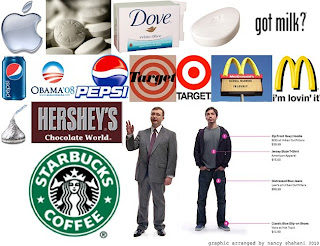
The creative mind convinced the consumer that Starbucks is worth the extra money since any product with a healthy green and mother earth branding cannot be all that bad for you. Target’s re-vamped logo brought a company back from the grave and suddenly represents products that are better designed and more in tune with a younger and hipper demographic than its competitors. Furthermore, the purity of Dove’s white soap is indeed the campaign for real beauty; one does in fact need to ask themselves if they “Got Milk?” as oppose to if they “Got Soy?”; it is the yellow arches of McDonald’s utopia which is the happiest and sunniest place for children to beg their parents to take them there; and those who drink Pepsi are indeed part of the new generation. The little girl innocent pink color of baby aspirin makes it okay to give a child; and one harmless white aspirin pill a day is good for the heart. Hershey’s chocolate will bring love into your life; and a MAC computer is more futuristic and humane than others; clearly noted by their everyman spokesperson Justin Long. Raj Patel’s book The Value of Nothing, begins with a quote from Oscar Wilde: “nowadays people know the price of everything and the value of nothing.” One can blame the creative mind for this.

Then we ask how happy are we broke? And how happy are we without? The happy medium would be the ideal – the problem is in knowing when enough is enough and when to stop buying and consuming. So do the graphic arts serve any good? Well, we can argue that people like things and they like to shop and we as humans need fantasy and luxury and more so desire to feed our drive, and as such, graphics help. But let’s talk about the accessibility of graphics since one cannot go without mentioning ‘the good’ that well designed graphics serve. Advertising can be used to raise awareness; from human issues, to world concerns, graphics can inform one of a non-profit organization, of health issues, and of political leaders. From the public art of billboards to the target marketing of direct mailers, graphics can help initiate change – and dare we say aid to saving the world.

Friday, February 12, 2010

Do We Share our Passion for Reading?

Guest Blogger: Joanne DeBoy

Reading is a subject and a process that reaches all levels of the education world and is a topic of discussion by students, parents, teachers, professors and politicians. It has been used as a political football in terms of funding; Should schools/programs receive funding for their poor reading performance? Should schools receive incentives monies for exceptional reading performance as measured on a standardized test? Debates ensue as to which strategy should be used to improve reading performance by those in the field and well as by those without formal education in the psychology of reading (the process). Some questions that confront the reading field today are:
  • What is meant by “proficient” reading performance?
  • Do standardized tests deliver what they purport to deliver?
  • How can we obtain the critical reading performance levels of 53.2 million K-12 students in a cost-efficient manner?
  • How does critical thinking relate to reading comprehension? Can critical thinking be taught?
  • Which instructional approach is more beneficial: top-down or bottom-up?
  • How and to what extent does decoding and phonemic awareness relate to reading performance?
  • How has the view of reading instruction changed with the increased use of technology?
  • Given the wide range of available electronic information, will books be essential in the future?
  • Will email, texting, etc. undermine or enhance writing/reading proficiency?

Despite the many discussions regarding the above topics and many more issues, the numbers of students in the United States who are avid and enthusiastic readers is shockingly small (Guthrie, McGough, Bennett & Rice, 1996). Research suggests that even those who have the cognitive ability to read choose not to read; thus, they have been dubbed “alliterate”.

Reading instructional programs designed to improve students’ performance have been in the K-12th grade curriculum since the establishment of normal schools (teacher preparation programs) and has been in the media recently, courtesy of the federally-funded No Child Left Behind mandate. However, the reading instruction issue does not stop at the basic education level; both community colleges and 4 year colleges and universities have recognized the need for reading support and instruction for college students for some 35 years. This, too, has engendered heated discussion at many levels.

Four years ago, Lincoln University’s Board of Trustees, administrators and many faculty members identified the need to require our students to read beyond assigned textbooks. For that reason we have been creating a reading list of books that students should read. It should be noted that Lincoln University is not alone in providing a reading list of extra-curricular books with content to which our college students should be exposed.

However, I am recommending an additional step to enhance a love of reading based upon research by Applegate and Applegate (2004) that connected the teaching of reading (or any other subject) to the Peter Effect. The subjects in the research were pre-service teachers, many of whom mirrored the reading behaviors of many college students: they have the cognitive ability to read but choose not to do so. The authors identified the problem in somewhat biblical terms, recalling the story of Apostle Peter who, when asked for money by a beggar replied that he could not give what he did not have (Acts 3:5). The research finding was disheartening; many pre-service teachers do not have a love of reading to pass on to students. How can teachers/ professors give what they do not have—a love or passion for reading, learning or specific content? How can we share the feelings, the insights, the connections and relevancy that we receive through the written word if we don’t possess it ourselves? We must share that love of reading that we feel when we reflect on those books that resonated with us, touched our souls and remained a part of our very being. Those are the books, ideas, topics, essays that we need to share with our students so that they might become afire with a love of reading/learning.

A book that was recommended by the Biology Department for the Lincoln University Reading List, still being developed, was “The Double Helix” by Watson and Crick (1951). I was moved to remembering the pictures I had in my head in my earlier college years when I was given the assignment to read that book. I can still visualize the two graduate student researchers in the early years of their careers doing their work and discussing their ideas about DNA in that small cluttered room. I don’t remember if the book was assigned for Biology, Microbiology or the Physiology of Behavior but I do remember connecting to those graduate students doing their research as I read that book.

There are reading skills and strategies that can be taught to students to help with their reading comprehension. However, most college professors have not had formal instruction regarding the reading process, reading skills or strategies. What all educators should model to our students is our love/passion for reading and learning and what we have experienced through the written word.