- Should we be developing more totally online courses? (If so, should they be options for our current students or just for new, non-resident populations?)
- Should we be developing totally online programs? (If so, in what disciplines and why?)
- Should we be focusing mainly on hybrid courses [= classes still meet face to face but some of the normal seat time is replaced by online activities]? (If so, how do you see them enhancing student learning?)
- Should we at least be encouraging web-enhanced learning in our classes [= regular seat time but more assignments using Internet-based resources] ? (If so, what training/resources do you need to do so more effectively?)
Showing posts with label course management system. Show all posts
Showing posts with label course management system. Show all posts
Saturday, April 11, 2015
Online? Hybrid? Web-enhanced?
What, from your perspective, should Lincoln most productively be doing with respect to online teaching and learning?

Saturday, November 22, 2014
Socrates or Social Media: How Do Our Students Want to Learn?
Is higher
education’s focus on learning technologies helping students to connect with
each other and the subject area content so as to learn easier and better, or
is it separating them from each other and from the higher order learning that occurs through interpersonal communication? The picture below of a group of Dutch school
children circa 1930, walled off from each other behind the “learning
technology” of the day, made me stop and think.

This picture,
from a Nov 7, 2004 article in Vitae by Kirsten Wilcox, was used to underscore
her argument that “the classroom as a space for human interaction has become a
luxury in higher education,” and that it is precisely this human interaction
that students today need, connected as they already are technologically by
email, Facebook, Twitter, and all the others.
“Ten years ago,”
Wilcox argues, “using course blogs, wikis, or online discussion forums to teach
was an exciting innovation, which students embraced.” Today, she says, things
are different: “Not only have these platforms lost the aura of immediacy and
creativity that they once had, but students have little desire to add an
intellectual online persona to the profiles that they cultivate across multiple
media.”
As a long-time
proponent of technology-enhanced teaching, my viewpoint has always been,
“Students like technology, so they will learn more willingly and more deeply if
the course offers them a chance to use those tools.” Clearly, it’s not that cut
and dried. What do you think? Should we be trying to provide our students
with the “luxury” of modern, technology-driven best practices in learning or the
“luxury” of personal, face-to-face, in-class presence? And if the answer is
“both,” (as it almost always is) how do you make that happen?
Sunday, November 28, 2010
Teaching with Technology
Guest blogger: Maribel Charle Poza
Teaching with Technology
When one looks around Lincoln University these days, there is little doubt that, as far as technology is concerned, we are in a new era. As new buildings rise and others are renovated, we find our classrooms equipped with the best and the newest that instructional technology has to offer. Our old blackboards were replaced by smart boards. We went from maybe having a television monitor in the classroom to having unlimited access to a computer connected to the Internet. At the language laboratory, we moved from cassette tapes to digital files and from CDs to streaming audio from the Internet. Next semester, the university will migrate our online content from obsolete WebCT to new and exciting Desire 2 Learn.
This technological transformation offers a world of possibilities, but also comes with great challenges. Many find themselves wondering if the benefits compensate for the expensive and time consuming nature of teaching with technology. The learning curve can be steep for some, while for others it is hard to find useful ways to incorporate the new tools into their current teaching. Finally, appropriate use of the technology by students can become an issue, especially in those classrooms that double up as computer labs.
It is my hope that the answers to the two questions that I pose in this posting and the comments from the faculty will help those who find themselves at a loss when it comes to integrating technology. The premise of this posting is that while I acknowledge the challenges that come with technology, I believe that it is after all only a tool and that it is the user who determines if it enhances or hinders the teaching and learning process.
Why should I use technology in my teaching?
There are many possible answers to this question. Some would say that if technology is available and a great investment has been made, then it must be used. Others may say that technology is present in the student culture and that we should capitalize on that fact to motivate our learners. A few may point to the fact that there is a great deal of pressure in academia to use technology, as shown in the majority of position announcements in our profession.
These are all valid answers, but they miss the real value of technology integration: We must use technology to provide better learning opportunities to our students. In other words, technology must always be at the service of good teaching, either enhancing our current practices, or allowing us to teach our students in new ways. Therefore, before we decide whether to use a specific tool we must always ask ourselves this question, will this technology improve the teaching and learning process or is it just innovative but non-essential?
How are you using technology?
These are a few examples of how I have used technology at the service of my teaching. I use the communicative approach to language teaching, so my main goal is to provide additional opportunities for my students to communicate in Spanish:
These are by no means the only ways that I could have used the tools available and I am constantly seeking new methodologically-sound means to enhance my teaching through the use of technology. However, I know that most of us on campus are making excellent use of the technologies that we have available. It would be very helpful for all of us to share our ideas in this blog for others to read and maybe adapt to their classes. Please write your comments to this posting and add your ideas on how to make the best use of technology and how to overcome some of the challenges.
Teaching with Technology
When one looks around Lincoln University these days, there is little doubt that, as far as technology is concerned, we are in a new era. As new buildings rise and others are renovated, we find our classrooms equipped with the best and the newest that instructional technology has to offer. Our old blackboards were replaced by smart boards. We went from maybe having a television monitor in the classroom to having unlimited access to a computer connected to the Internet. At the language laboratory, we moved from cassette tapes to digital files and from CDs to streaming audio from the Internet. Next semester, the university will migrate our online content from obsolete WebCT to new and exciting Desire 2 Learn.
This technological transformation offers a world of possibilities, but also comes with great challenges. Many find themselves wondering if the benefits compensate for the expensive and time consuming nature of teaching with technology. The learning curve can be steep for some, while for others it is hard to find useful ways to incorporate the new tools into their current teaching. Finally, appropriate use of the technology by students can become an issue, especially in those classrooms that double up as computer labs.
It is my hope that the answers to the two questions that I pose in this posting and the comments from the faculty will help those who find themselves at a loss when it comes to integrating technology. The premise of this posting is that while I acknowledge the challenges that come with technology, I believe that it is after all only a tool and that it is the user who determines if it enhances or hinders the teaching and learning process.
Why should I use technology in my teaching?
There are many possible answers to this question. Some would say that if technology is available and a great investment has been made, then it must be used. Others may say that technology is present in the student culture and that we should capitalize on that fact to motivate our learners. A few may point to the fact that there is a great deal of pressure in academia to use technology, as shown in the majority of position announcements in our profession.
These are all valid answers, but they miss the real value of technology integration: We must use technology to provide better learning opportunities to our students. In other words, technology must always be at the service of good teaching, either enhancing our current practices, or allowing us to teach our students in new ways. Therefore, before we decide whether to use a specific tool we must always ask ourselves this question, will this technology improve the teaching and learning process or is it just innovative but non-essential?
How are you using technology?
These are a few examples of how I have used technology at the service of my teaching. I use the communicative approach to language teaching, so my main goal is to provide additional opportunities for my students to communicate in Spanish:
Course Management Software (WebCT): I have integrated this technology to create computer-mediated communication opportunities to my students through the use of tools such as chat rooms and bulletin boards. I have also used WebCT to expose students to authentic input in Spanish through the integration of audio and video files in the language with myself and teaching assistants as actors.
Language Laboratory Technology: Elementary and intermediate Spanish courses include weekly laboratory sessions where students are exposed to different varieties of the language in different formats. Students listen to different varieties of the language, they view educational and authentic videos, and they record themselves speaking in Spanish.
Smart Boards: The addition of this tool to our classrooms has helped me to provide high-quality visual aids to improve student comprehension of the Spanish language. It has also served to increase student motivation and knowledge by becoming a window to the culture of Spanish-speaking countries.
These are by no means the only ways that I could have used the tools available and I am constantly seeking new methodologically-sound means to enhance my teaching through the use of technology. However, I know that most of us on campus are making excellent use of the technologies that we have available. It would be very helpful for all of us to share our ideas in this blog for others to read and maybe adapt to their classes. Please write your comments to this posting and add your ideas on how to make the best use of technology and how to overcome some of the challenges.
Tuesday, March 30, 2010
How Not to Become Tools of Our Tools
Guest Writer, Nancy Evans
We have been using WebCT since 1999 and it is soon to be defunct when Blackboard, its current owner, will no longer support it. I have invited faculty to review some options and we have narrowed our search to Desire2Learn, a Canadian company which has managed to escape Blackboard's buyout, and Moodle, an open source course management system supported by Moodlerooms.
Let's clarify. An open source course management system is based on software which is not copyright protected. Since the source code for the software is available to anyone, users may change it, add to it and improve it as they see needs arise. And it is free.
So, why use a course management system? It is most advantageous to non-traditional students who may live at a distance from campus or cannot come to campus for classes. But these are not the only students who can benefit.
Perhaps an instructor wants computer-based or internet-based enhancements to their instruction. This is done by giving students access to specific information, access to each other in discussion groups, by calculating and posting grades online, by creating test banks and controlling access to tests, or by providing a learning environment very different from a traditional classroom — all in a password-protected online world.
And what about the online world at large? How can one gain access to people and information on the internet? A course management system can gather in one place controlled access to social networking tools and provide guidelines for students working on the internet.
Let's clarify. Social networking tools are free internet-based applications that allow one to share information and media with others. Examples include the ubiquitous Facebook, blogs, Twitter, YouTube, and Flickr, as well as the somewhat lesser-knowns, such as Ning, Meebo, dimdim, and SlideShare (see the ATS website for explanations). Note that though you may be able to control your privacy to some extent, you should consider social networking tools as opening your life up to the world.
So why not use a blog instead of a course management system? Simply put, ease and control. Most course management systems are quite linear in design, offering a default set of elements: drop box, discussion list, gradebook, chat room, email. These tools reflect a fairly traditional teaching approach - presentation, discussion, assessment - and most instructors use these elements easily and successfully. And most instructors are effective in classes organized on this model, whether in class or online. Here is a traditional course management system.

However, more modern course management systems offer more customization and new features associated with social networking tools, such as wikis and blogs. The course itself can look different and can be laid out as a portal (or not - there are choices). The portal layout will still give access to the traditional course management tools, but it changes how the instructor designs the course and how students interact with the tools. The portal design looks more like a website or a blog and may encourage delving into the tools to see which ones serve one's needs and which tools will further the learning objectives of the course.
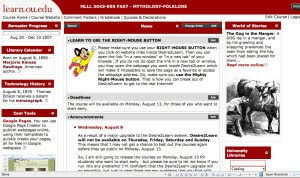
Most instructors want to know what a course management system - or any technology - can do and how hard is it to learn. I think a better question is how can a course management system, or any technology, meet my pedagogical goals and my students' learning objectives?
How might an instructor's choice of course management tools be affected or determined by learning objectives? Consider these broad learning objectives:
- Students will demonstrate a depth of knowledge and apply appropriate methods of inquiry
- Students will interpret information, respond and adapt to changing situations, make complex decisions, solve problems, and evaluate actions
- Students will demonstrate the inclination to be life-long learners, a concern to become and remain well informed, the ability to retrieve and manage information appropriately, open-mindedness regarding divergent worldviews, and a willingness to reconsider and revise their own views when warranted (K-State Undergraduate Student Learning Outcomes. http://www.k-state.edu/assessment/slo/undgradobj.htm Retrieved 3/30/10).
- How is a student's understanding of drug rehabilitation programs (for example) enhanced by access to actual programs and counselors online? How can that knowledge be share and compared with other students, even those at other universities?
- How does a student-run blog help students interpret, respond and adapt to new information?
- How can an instructor encourage students' innate or latent curiosity in a subject with internet and course management tools?
We will move into a new phase of online learning and teaching when we choose a new course management system. How will we make our courses more effective, more responsive to learning objectives, more responsive to students? How can we enrich our students' learning? What new tools, or old ones, will we choose?
And, finally, how will we avoid this technology trap:
"Men have become the tools of their tools." -- Henry David Thoreau, Walden
Subscribe to:
Posts (Atom)

